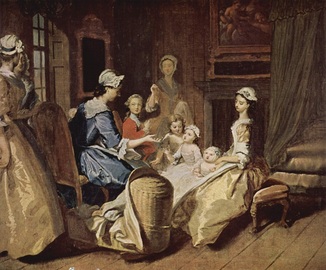
Joseph Highmore's illustration of Pamela teaching her children (1743–45)
As a person of Arabic origin in New Zealand, I often encounter claims that women in the Middle East suffer from inequality that women in the west do not. However it is true that New Zealand society is divided in a number of ways. One of the divisions is along the lines of gender. Inequity between women and men in New Zealand society can be seen in a variety of ways in the workplace.
Firstly, the Gender Pay Gap (GPG) shows that men are paid more than women for the same jobs and across professions. For example in June 2011 there was a 28% GPG in weekly earnings. This shows gender inequity horizontally across employment.
Historically, New Zealand prided itself on the 'family man’s wage' where a man was paid enough to look after a wife and children. Women were deliberately paid less than men as they were seen to not have this responsibility. In 1972 the Equal Pay Act was passed however in 2011 statistics there was still a marked inequality between the pay of men and women. Now the case is that an average income family needs two incomes to survive.
Secondly, gender inequality runs vertically through employment. Women are under-represented in leadership roles in New Zealand and this is particularly evident in the professions that have high numbers of women. The terms used to explain this are the ‘glass ceiling’ and the ‘glass elevator’.
The glass ceiling is where women find that they reach a level of leadership and then are overlooked for promotion. Arguments for this discrimination have included that that women have children and can’t commit to a job the same way men can. This shows how capitalism is androcentric as men are valued for their ability to commit to work, but that availability only comes from the unpaid work done by women to enable the man to be available.
On the other hand, the glass elevator is where men in women dominated industries, such as education and nursing, are promoted quickly to positions of leadership. Research has shown that white men in particular need to work hard to not be promoted into management as many people, including men and women, feel uncomfortable if a white male stays in what many consider a woman’s job. An example of this in New Zealand is that in over 70% of teachers are women, but 53% of principals are men. This is an example of hegemonic masculinity where men are placed in a dominant position of power by the desire and consent of society.
Women face inequality all over the globe and New Zealand in no exception.
Firstly, the Gender Pay Gap (GPG) shows that men are paid more than women for the same jobs and across professions. For example in June 2011 there was a 28% GPG in weekly earnings. This shows gender inequity horizontally across employment.
Historically, New Zealand prided itself on the 'family man’s wage' where a man was paid enough to look after a wife and children. Women were deliberately paid less than men as they were seen to not have this responsibility. In 1972 the Equal Pay Act was passed however in 2011 statistics there was still a marked inequality between the pay of men and women. Now the case is that an average income family needs two incomes to survive.
Secondly, gender inequality runs vertically through employment. Women are under-represented in leadership roles in New Zealand and this is particularly evident in the professions that have high numbers of women. The terms used to explain this are the ‘glass ceiling’ and the ‘glass elevator’.
The glass ceiling is where women find that they reach a level of leadership and then are overlooked for promotion. Arguments for this discrimination have included that that women have children and can’t commit to a job the same way men can. This shows how capitalism is androcentric as men are valued for their ability to commit to work, but that availability only comes from the unpaid work done by women to enable the man to be available.
On the other hand, the glass elevator is where men in women dominated industries, such as education and nursing, are promoted quickly to positions of leadership. Research has shown that white men in particular need to work hard to not be promoted into management as many people, including men and women, feel uncomfortable if a white male stays in what many consider a woman’s job. An example of this in New Zealand is that in over 70% of teachers are women, but 53% of principals are men. This is an example of hegemonic masculinity where men are placed in a dominant position of power by the desire and consent of society.
Women face inequality all over the globe and New Zealand in no exception.



 RSS Feed
